
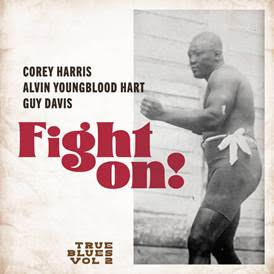
A niece once pronounced to me that all the great blues musicians are dead. Alvin Youngblood Hart, Guy Davis and Corey Harris show that’s not true, as they are among the best blues masters of my own generation. With Fight On! True Blues Vol. 2, these masters have created an acoustic blues timepiece that is ethereal yet vital as a reflection of their amazing, distinct musical voices.
I’ve followed all three of these contemporary bluesmen for many years. I saw Harris open for B.B. King in the mid-1990s (in El Paso of all places) and was hooked. He first gained notice with a pure Delta blues style with his straightforward lyrics and fantastic acoustic slide playing. As his following grew, he began incorporating Creole and reggae influences. Greens from the Garden, 1999, was the best of his early work. In 2003, Harris was featured in Martin Scorsese’s film Feel Like Going Home, which was the first installment in the Scorsese-produced series The Blues on PBS. After travelling to Mississippi and West Africa for the Scorsese film, former MacArthur Fellow Harris released his own masterful CD, Mississippi to Mali, using some of the connections he had made during filming. With Daily Bread in 2005, Harris explored reggae, coupling rasta numbers with traditional blues. Zion Crossroads in 2007 defied any notion Harris could be pigeonholed, with a pure reggae effort – and a great one at that. Since then, Harris has seesawed between genres, touring with his “Rasta Blues Experience” putting on amazingly eclectic shows that run from reggae to blues to jazz and recorded the self-released Father Sun, Mother Earth in 2011. With Fulton Blues in 2013 and Insurrection Blues in 2021, Harris returned (mostly) to his acoustic blues roots.
Hart, meanwhile, has been a prominent acoustic bluesman since the mid-1990s. His style is raw and unvarnished. Originally from California, Hart frequented blues venues in Mississippi and Chicago on his family’s travels, and he reportedly took his stage name “Alvin” (he was named Gregory at birth) from Alvin & the Chipmunks. After a stint in the Coast Guard in the 1980s, he concentrated on his music career, releasing his acclaimed debut album, Big Mama’s Door, recorded at Grateful Dead guitarist Bob Weir’s studio, in 1996, and was a featued performer on the Further Festival tour along with the likes of Hot Tuna, Los Lobos and Bruce Hornsby. He released a handful of albums thereafter, including the electric Motivational Speaker in 2005. His 2003 album, Down in the Alley, received the Grammy for Best Traditional Blues Album. He’s also featured in numerous collaborations, including as a member of South Memphis String Band (featuring North Mississippi Allstar Luther Dickinson and Squirrel Nut Zipper Jimbo Mathus) and New Moon Jelly Roll Freedom Rockers (archival recordings released by Dickinson in two installments featuring the SMSB principals plus Charlie Musselwhite and Jim and Cody Dickinson). And his music was featured in the soundtrack for the Oscar-nominated movie Sinners.
Davis has forged a similarly independent path in acoustic blues. He is an amazing performer (I saw him do a solo show at the intimate Twisted Tail in Philadelphia). The son of African-American entertainment royalty, actors Ossie Davis and Ruby Dee, Davis embraced a predominantly country-blues expression echoing Mississippi John Hurt and John Lee Hooker, despite his New York City upbringing. His clever song writing and refreshing takes on others’ compositions could be heard on albums like Stomp Down the Rider (1995), Butt Naked Free (2000), Give in Kind (2002), Chocolate to the Bone (2003) and Skunkmello (2006). I selected his 2015 release, Kokomo Kidd, as one of the best blues-based albums that year, and his 2017 collaboration with blues harp specialist Fabrizio Poggi, Sonny and Brownie’s Last Train (featuring the music of Sonny Terry and Brownie McGee), was a masterpiece. And his 2021 release, Be Ready When I Call You, with its political overtones, was deservedly nominated for a Grammy, and The Legend of Sugarbelly, released in 2024, was simple, stark and beautiful.
Harris, Hart and Davis have worked together before. They were first assembled by Otis Taylor (along with Keb’ Mo’ and Don Vappie) for Taylor’s 2008 concept album, Recapturing the Banjo, which highlighted the use of the banjo – originally a West African instrument – in African-American music. They reunited in 2013 for True Blues (Vol. 1), which also featured Taj Mahal, Phil Wiggins and Shemekia Copeland.
For Fight On! True Blues Vol. 2, Davis summed up the team’s motivation: “The fight we are waging is to keep this precious music form alive. To us, there is not so much difference between our arrangements of blues classics and our newly created work. It’s all connected to the ancestral spirit.” The vocal styles of each of the three are distinctive, and the songs are great. Among the highlights are Harris singing Jimmy Strothers’ traditional “We Are Almost down to the Shore (Fight On),” Hart singing Charley Patton’s “Screamin’ and Hollerin’ the Blues,” and Davis’ “Deep Sea Diver.”
 About the author: Bill Wilcox is a roots music enthusiast recently relocated from the Washington, DC area to Philadelphia, PA and back again.