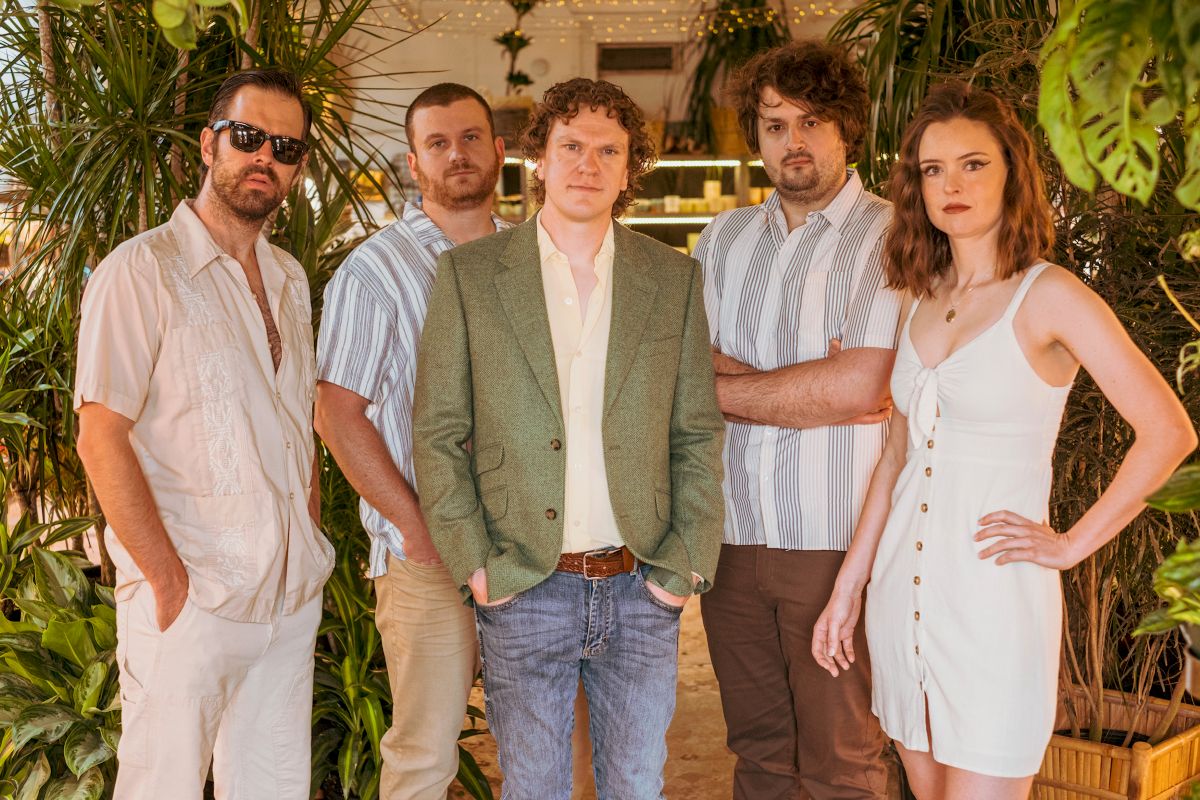
Photo credit: Scott Simontacchi
Tell us about your tour vehicle. Any notable breakdown stories?
James Kee: Our rig is a 2018 Ford Transit extended, high roof, dual rear wheel van. We bought it from the original owner and it’s been a great rig for hauling all of our band and crew plus towing a tandem axle enclosed trailer for all our sound gear, clothing, and merch. It has about 190k miles right now and has had a few minor repairs along the way but that is to be expected for as many miles as we drive.
I used to own and operate a fleet of 15 trucks when I was in the landscaping business so that gave me good practice to keep on top of maintenance and avoid any catastrophic failures that can put us in danger. We did blow a tire on our way to a gig in Mississippi in May and thanks to the dual rear wheels we limped in right on time for sound check and changed it after the show.
How do you eat cheaply and/or healthy while on tour?
Harry Clark: Sadly, both eating cheaply and healthily on the road don’t often coincide. However, in more established cities and metro areas it is easier to find food that is easier on the body and more nutritious than when in very rural areas.
How many strings do you break in a typical year? How much does it cost to replace them?
Cory Walker: I generally break 1 or no strings a year. Luckily GHS keeps me stocked, so it doesn’t cost much at all! Thanks GHS!
Clark: In this economy, I can’t afford to break strings because I have to pay full price for them.
Maddie Denton: I don’t break very many strings, except the occasional E string when I bear down too hard, which is not ideal. The gear that requires the most maintenance is my bow, which my good friend Tyler Andal made for me. I break a lot of hair on my bow (again, from bearing down too hard haha), so I have to get it rehaired about once every 2-3 months, depending on how many shows we are playing. Tyler handles all of my bow repair needs and any fiddlers reading this should check out Tyler’s work and get on his waitlist for a bow.
Where do you rehearse?
Denton: We don’t necessarily have a designated band rehearsal space; we just get together at our houses in Nashville whenever we need to run tunes and that works fine!
What was the title and a sample lyric from the first song that you wrote?
Denton: This is a tough question, and I guess it shouldn’t be if we were all just honest about our art. I’ll be honest, songwriting is a deeply personal and humbling thing that I’ve not felt very good at. The first song I ever wrote that I recorded was on my record I released in 2021, called Playin’ in This Town. The song is called “Within My Heart,” and I wrote it in sadness one day when I was thinking about life’s many changes. One line that I like from it is “Like a whisper of the wind, drifting through the trees, you linger in my soul and fill my mind with memories.”
Describe your first gig.
Walker: The first gig I played was for a private event in Florida, though I can’t remember the town. I was 11 and had just been hired as the banjo player for Tom Henderson’s “Bluegrass Parlor Band”, based out of Tampa. I was just thrilled to be in a real band! I can’t believe Tom had enough confidence in a kid, though I’m glad he did, as it taught me more than I probably even realize.
Kee: August 2002 I played a wedding reception with a local band called Tri-State Bluegrass at Pearl’s on Monteagle Mountain, TN which constituted my first paid gig. I made $36 dollars and honestly I’ve had several gigs even in recent history that didn’t pay that rate so I think adjusted for inflation it was pretty damn good.
What was your last day job? What was your favorite day job?
Clark: The last non-music day job I had was driving around an Isuzu long bed delivery truck, delivering lawn mowers for a lawn equipment company in Nashville. I drove anywhere within a 100 mile radius of Nashville, which gave me the opportunity to explore some of the backroads of the middle Tennessee region, which I would have never seen otherwise.
I also worked in a kitchen in downtown Little Rock at a pizza place that’s no longer there. It definitely threw me into a different cultural setting I’d never seen before. It opened my eyes to a lot of the behind the scenes operation of everyday establishments that most folks don’t get to see.
I was also a CNA for a little over a year, which grew me as a person; I can’t say it was my favorite but it was definitely the most formative job I’ve ever had.
Denton: Before I was a full-time musician, I was a high school biology teacher, so I played music at night and on the weekends. It was tough balancing two touring bands (at that time I was also playing fiddle for the Dan Tyminski Band in addition to East Nash Grass) AND teaching 130+ kids every day, but I did it for 5 years before “retiring” in 2022 to pursue this career in music. I enjoyed a lot of parts of my job; I coached golf and basketball in addition to teaching biology, and I loved my coworkers and students at Siegel High School. But I just couldn’t balance it all and I knew I had to follow my heart, so in February of 2022 I gave my notice that I wouldn’t be returning in the fall. It was hard, but I’m so glad that I decided to do the scary thing and chase this dream of mine: to travel the world playing music with musicians that inspire me every night.”
How has your music-related income changed over the past 5-10 years? What do you expect it to look like 5-10 years from now?
Kee: Without sharing any specifics related to our corporate structure and pay rates I can say that I pay my bills using money made from playing music. I often lament that there was a professional era before my time where artists made a considerable amount of their income via songwriter royalties and physical product sales (CD, tape, vinyl), and I can bet that it must be harder to make a living today. So many artists including us resort to becoming traveling apparel companies that play music to generate revenue. I think everyone can “make it” a little differently but there’s no doubt artists have to be versatile and try to generate revenue from as many sources as possible, which is true of any business; but damn it would be nice if streaming pay rates weren’t low to a point they are demeaning. I applaud anyone in Congress who is working on legislation to amend this and I am hopeful in another 5-10 years we could see increases in both streaming and songwriting royalties but in the meantime it feels like the streaming business model snuck up on the music business and the legislation to protect artists is years behind where it should be.
What one thing do you know now that you had wished you knew when you started your career in music?
Kee: I wish I had appreciated the importance of the songwriters when I was growing up. I’m from Chattanooga, TN and some of the songwriters in the area were technically bad musicians, and maybe bad writers too. I never really got exposed to many amazing songwriters until I moved to Nashville. When I listened to them initially sometimes I would be put out by their limited technical ability to sing, or play an instrument. Yet in Nashville when I listened to the music these songwriters were creating I began to understand there are a lot of things that can define a person’s deep musicality besides proficiency at a particular instrument or the voice. I began to understand the art behind every aspect of creating music and I had really been dismissive of such an important component. This changed me as a musician and allowed me to be more aware, more respectful, and a better listener. I still enjoy polished proficiency with most of the music I listen to but with a new appreciation of each artists’ role in the fabric of my favorite