
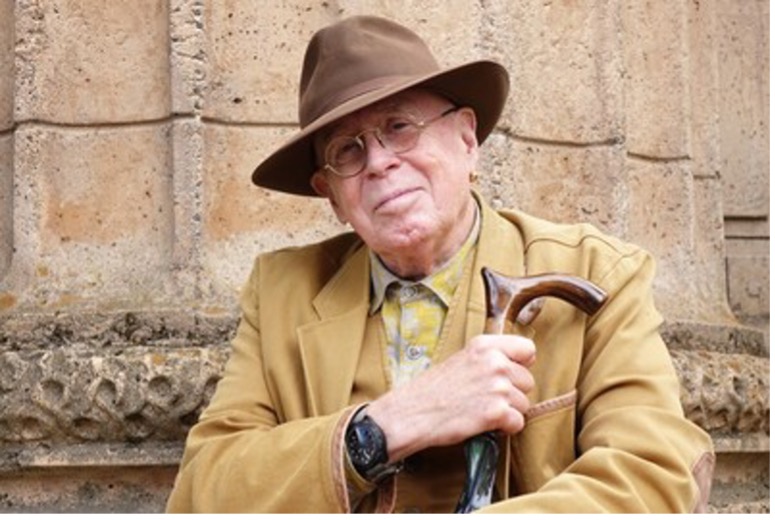
Bruce Cockburn has spent a lifetime accumulating other people’s music. Some songs became warm-up rituals, others a welcome escape from singing his own words. A few arrived by accident, a guitar figure leading him toward a melody he suddenly needed to learn. On The Blood of Others, due October 16 on Sunset Blvd. Records, the Canadian singer-songwriter follows those musical debts back to their sources, finding a life’s worth of memories in songs written long before his own career began.
The idea took shape in the eighties, though its roots reach back to Cockburn’s childhood in Ottawa. The album borrows its title from Simone de Beauvoir’s novel, written during the Nazi occupation of France and read by Cockburn in the seventies. Its questions of responsibility, oppression, and moral choice give the collection a weight beyond nostalgia.
These are other people’s songs, but their histories have become inseparable from his own.
Cockburn was 11 in 1956 when older boys at summer camp sang Bill Haley’s “Rock Around the Clock.” He thought they sounded ridiculous. The following year, Elvis Presley arrived on the radio, and the young Cockburn changed his mind about rock ’n’ roll.
“I just kind of fell for that music hook, line, and sinker,” he recalls. “It was the vibe. We were interested in him. But it was the records that just had this great power. And I never got to see him live. I saw him on TV a couple times.”
It was the records, more than the celebrity, that got him. “Hound Dog” and “Blue Suede Shoes” carried a charge he couldn’t resist. Cockburn retrieved a cheap guitar from his grandmother’s attic, painted gold stars on it, and posed in front of a mirror. His parents agreed to support his playing if he took lessons and promised to avoid leather jackets and sideburns.
The lessons opened other doors: jazz, country swing, blues, ragtime, classical music. Elvis had provided the entrance, but Cockburn kept moving through the rooms. His arrangement of “That’s All Right” returns to Arthur Crudup, the blues musician who recorded the song before Presley made it a rock ’n’ roll landmark.
Elvis was an introduction. He was a lesson. He was a segue. He was a starting point to go deeper into music. Radio was another kind of education. Cockburn remembers going home from school for lunch while his mother prepared the meal with the radio playing. Later, a transistor radio tucked beneath his covers let him tune into distant stations, including WWVA in Wheeling, West Virginia, for country music. A Buffalo station delivered harder-edged rock than the local Ottawa broadcasters.
“You could tap into it,” he says. “You had this tiny transistor radio and you could start discovering other types of music.”
Daytime radio might put Frank Sinatra alongside Johnny Cash, Brenda Lee, or Jerry Lee Lewis. The boundaries between styles were less rigid, and the young listener could follow his curiosity wherever it led. When the Beatles arrived, Ottawa’s folk community went wild, learning the songs and imagining that perhaps they, too, could become the next Beatles. Cockburn eventually turned away from contemporary songwriters to develop his own voice, listening instead to Renaissance music, Pacific Island drumming, and Tibetan chanting.
But the American musical experience remained a lasting point of reference. Mississippi John Hurt’s “Louis Collins” takes Cockburn back to an afternoon in 1963, when a friend played him Hurt’s rediscovery album. The sweetness of Hurt’s voice and the intimacy of his fingerpicked guitar made an impression that endured. W. C. Handy’s “Yellow Dog Blues,” which Cockburn first heard through Bessie Smith’s recording, reaches into the vocabulary and geography of the Mississippi Delta. The title itself carries a local reference: “Yellow Dog” was slang for the Yazoo Delta railroad.
Other songs arrived through unexpected detours. Jo Stafford’s “You Belong to Me” was on the radio when Cockburn was five. Its references to faraway places stirred his wanderlust years before Jack Kerouac’s On the Road added fuel to it. Billie Holiday’s “God Bless the Child,” written with Arthur Herzog Jr., entered his life through a likely bootleg copy of Harry Belafonte’s Belafonte Sings the Blues, purchased with his collection money around 1960 or 1961. Hearing Holiday’s original a couple of years later gave the song a different force.
In Paris in 1964, while busking for pocket money, Cockburn spent some of his earnings on American blues and jazz records, including music by Lonnie Johnson. Five years later, he saw an advertisement for Johnson’s appearance at an Ottawa supper club. Cockburn and his friends dressed up and went. During a break, they requested “Laplegged Drunk Again.” Johnson smiled but explained that he couldn’t play it in a place like that. Some blues, apparently, required a less respectable address.
Cockburn’s own apprenticeship had unfolded at Le Hibou, an Ottawa coffeehouse where Reverend Gary Davis, Brownie McGhee, Sonny Terry, and Ian and Sylvia performed. Cockburn washed dishes, ran the espresso machine, and eventually took the stage for open-mic nights. He remembers Davis as a crusty, intelligent musician whose guitar was famously out of tune by ordinary standards. Once, an audience member tried to correct it during a break. Davis returned, struck a chord, and demanded, “What the fuck wrong with this?”
The old songs carry such stories with them: the people who played them, the places where they were heard, and the listeners who never quite forgot them. Cockburn’s collection moves from gospel and blues to early jazz, French poetry, and the lonely intimacy of “One for My Baby.” Each selection has its own lineage, and each has found a place in his musical life.
At 81, Cockburn is not simply revisiting the records that shaped him. He is listening again, with the perspective of a musician who has spent decades learning how much there is to hear. The songs have outlived their original moments, crossing borders and generations without losing their power to surprise.
“The deeper you go, the more there is.”
 About the author: A devout lover of singer-songwriters, mountain hikes, colorful cuisine, and eccentric artists, Brian D'Ambrosio lives in Santa Fe, New Mexico. For story ideas and suggestions, he may be reached at dambrosiobrian@hotmail.com.