
Country music has always had room for musicians whose ambitions exceed their prospects. Ian Noe gives those musicians a whole album on Canyon Falls Trailer Band, imagining a group taking its shot at a Nashville showcase. Gram Parsons makes a fitting companion: an artist whose attachment to traditional country helped expand what younger songwriters could do with it. The connection becomes especially clear when Noe introduces some interstellar visitors with country music on their minds.
Now
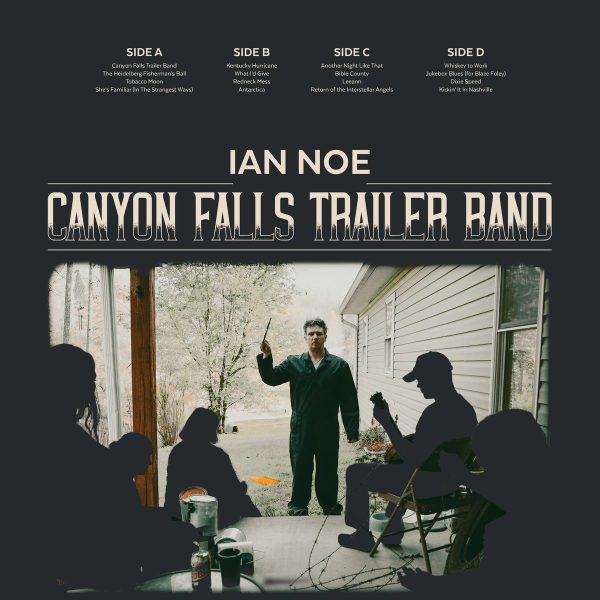
Released September 25, 2026, Noe’s third album stretches across 16 songs, with producer Andrija Toki? helping accommodate its shifts between honky-tonk and quieter storytelling. Billy Contreras’ fiddle gives the title track its lively introduction; Russ Pahl’s pedal steel supplies an answering voice on “The Heidelberg Fisherman’s Ball.” That song’s unsuccessful riverside courtship brings welcome humor. “Tobacco Moon” turns toward violence, while the sparse “Jukebox Blues (For Blaze Foley)” gives the record a more intimate register. The fictional band provides a premise broad enough to accommodate these changes without requiring every song to advance the plot.
Then

Parsons’ Grievous Angel, released posthumously in 1974, achieves a comparable breadth in a considerably shorter running time. “Ooh Las Vegas” makes room for exuberance beside the wounded intimacy of “Love Hurts.” Emmylou Harris is essential to that emotional range, her singing turning performances into exchanges between two people. James Burton’s guitar contributes precision without making the record feel overly polished. Parsons helped establish a durable country-rock approach: traditional playing could support songs with a restless, contemporary sensibility.
Parallels
Noe makes the lineage unusually explicit on “Return of the Interstellar Angels,” which echoes “Return of the Grievous Angel” and references the Byrds’ Sweetheart of the Rodeo. The shared territory extends beyond those nods. Both records allow country music’s familiar sounds to carry unconventional stories, and both find room for pleasure alongside disappointment. Their arrangements matter because the instruments participate in the storytelling. A steel-guitar response can complicate a cheerful surface; a harmony can make a lonely narrator seem briefly less alone.
Breaks
Noe’s strongest distinction is his commitment to eastern Kentucky as a specific community. “The Heidelberg Fisherman’s Ball” draws on a real riverside location, while his larger project reflects the people and experiences of his home region. Parsons’ record feels more concerned with movement and longing, its emotional center often formed by his partnership with Harris. Noe’s fictional showcase also introduces an industry question: what happens when music rooted in one place seeks approval somewhere else? That gives his traditional country arrangements a particular dramatic purpose.
Liner Notes
Start with the two “Return” songs, then pair “Jukebox Blues (For Blaze Foley)” with “Love Hurts.” The first pairing makes the historical connection clear; the second reveals how much expressive room these artists find in restrained performances. Grievous Angel helps explain the possibilities Noe inherits. Canyon Falls Trailer Band puts those possibilities to work for a different place, with characters whose stories deserve the extra time.
 About the author: Gainesville, FL area creative by day. Music is my muse. I host Twangville’s weekly Readers‘ Pick.