
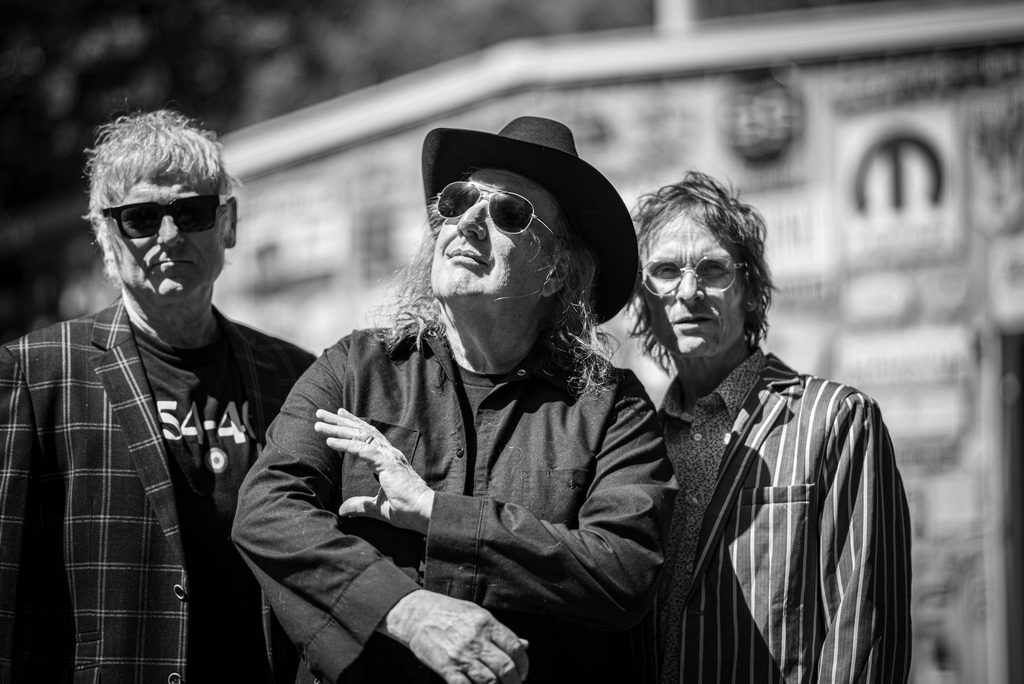
Several days after speaking with Kevn Kinney, I watched a storm roll across the mesas outside Taos, New Mexico. Purple lightning split the sky, eventually forcing Drivin N Cryin’s scheduled outdoor performance indoors.
The band adjusted. Instead of the full-throttle rock show one might expect from a group that has spent nearly four decades making noise, they settled into a softer, more circumspect acoustic set.
It seemed appropriate.
Kinney has spent much of his career learning how to listen to what remains after the noise falls away.
Nearly 40 years after Drivin N Cryin began in Atlanta, Kinney is still writing songs, making records, walking dogs, doing crossword puzzles and thinking about words. At 65, he has no interest in embalming the past. The old songs remain alive, but they are not monuments. They are evidence.
The newest evidence is Crushing Flowers, the band’s first studio album in several years, made deliberately and without the pressure of having to manufacture another product because a tour was coming. Produced by Sadler Vaden, it moves between rock, folk, orchestral color, humor and the plainspoken intelligence that has always marked Kinney’s writing. Peter Buck of R.E.M. appears, as does Todd Snider. The album has reached the Top 10 of the Americana Radio chart.
But the record’s deepest song is also its most intimate.
“Mirror Mirror” concerns Kinney’s mother and her battle with Alzheimer’s. It is not simply a song about disease, but about memory—what remains when it begins to malfunction, and what a son discovers when the past becomes more accessible than the present.
Kinney’s mother, now in assisted living in Milwaukee, can remember with astonishing clarity things that happened long ago. She can tell him about going to a baseball game with her father, taking the trolley and bus, sitting in the ballpark while he taught her how to keep score.
But she may not remember that Kinney visited her an hour earlier.
“That’s the hard part,” he says.
So he has learned not to interrogate memory. He asks questions and lets her wander.
On one visit, he took her out for coffee and drove her around the East Side. Landmarks awakened buried rooms in her mind. She began telling him about relatives and places he had never heard her mention.
The past was still there.
Somewhere.
That is the strange territory of “Mirror Mirror,” where memory becomes both refuge and heartbreak. Kinney sings toward a person who is still present but increasingly difficult to reach. He does not pretend to understand where she goes when the present disappears.
Maybe, he says, it is a safe place to wander.
For a songwriter, it is an unbearable mystery and an irresistible one.
Kinney has long been interested in the places where things disappear: memory, small clubs, roadside restaurants, independent businesses, the peculiar corners of America that get paved over and replaced by something more efficient and less human.
That concern runs through Crushing Flowers, particularly its title track. “Break away from the engine, break away from the machine,” he sings, turning the phrase into a plea to step outside the machinery of modern life.
Put down the phone.
Meet somebody at one o’clock and actually be there at one.
Stay home. Read something. Talk to somebody on the porch.
Kinney misses the old places—the diner where people know one another, the little restaurant, the independent club, the recording studio where musicians still walk through the door and work.
He still prefers the studio to recording at home. Three or four concentrated hours are enough. Then he goes home, listens and assesses.
He is not in a rush anymore.
That patience helped shape Crushing Flowers. Kinney took a year to record it, resisting the impulse to fill an album with whatever happened to emerge from sound checks.
Drivin N Cryin began in Atlanta in 1985, in the same broad Southern musical universe that produced or nurtured R.E.M., the Indigo Girls and the Black Crowes. Yet the band never fit neatly into any one of those worlds. They could be rootsy, loud, melodic, political, funny, ragged or tender.
Kinney saw the Ramones in 1977. Patti Smith mattered, as did Springsteen, 1950s doo-wop, Eddie Cochran, the Stones, Little Richard, Johnny Winter, Nick Lowe, Dave Edmunds, Elvis Costello, Black Sabbath and Led Zeppelin. Later came Bob Dylan, whom Kinney approached album by album, starting at the beginning and following the entire story.
He wanted the story.
That instinct remains.
Too Late to Turn Back Now, the band’s independent record produced by Clash associate Cosmo Vinyl, remains one of Kinney’s favorites. The band later opened for The Who during the Quadrophenia tour, an experience he remembers as a moment when everything seemed to line up.
It was also where a young Sadler Vaden first saw Drivin N Cryin.
Years later, Vaden would produce Crushing Flowers.
Then there is Mystery Road, another record worth reopening. “Straight to Hell” remains one of the band’s signature narratives, a rough-edged Romeo and Juliet story transported somewhere closer to a trailer park than Verona.
And then there is Fly Me Courageous, the album that made Drivin N Cryin a national rock band.
Kinney’s relationship with that record is complicated. It was the breakthrough, but the process left him uneasy. Everyone in the group was pulling toward a different musical horizon. Some wanted arena rock; others were listening to Hüsker Dü and Fugazi. Kinney was immersed in Dylan and other traditions.
He felt himself compromising.
Then Nirvana arrived and detonated the landscape.
Looking back, Kinney can hear the youthful mistakes, but he is also learning to forgive the younger man who made them.
That same generosity colors the way he talks about Todd Snider.
Kinney and Snider were close—close enough that Kinney sometimes stayed at Snider’s house, slept on an inflatable mattress and went along on the road simply as a friend. He describes Snider as a songwriter who never seemed to stop writing. They were alike in that regard, constantly working through what Kinney calls musical puzzles.
“He had a lot of great songs,” Kinney says. “He didn’t have a bad song.”
Snider was also a musicologist in the best sense. He knew where songs came from, who influenced whom, who introduced one musician to another. Kinney remembers Snider explaining the tangled lineage running through Bobby Bare, Kris Kristofferson, Willie Nelson, Johnny Cash and the musicians who helped form what is now called Americana.
Snider knew where he stood in that lineage.
He knew who came before him.
Kinney admired that humility. He also thinks Snider never fully understood how good he was.
That kept him working.
The two men were still in contact near the end of Snider’s life. Snider recorded the final verse of “Iggy Monkey,” the mischievous song that closes Crushing Flowers. Kinney had been working on the song when Snider brought him a painting he had made.
Kinney told him about “Iggy Monkey,” explaining that it was essentially Iggy Pop showing up at a monkey’s house and stealing their car.
Snider wanted to sing the last verse.
He did.
So Todd Snider gets the last word on Crushing Flowers.
A month or so before Snider died, he was in Atlanta and played what Kinney considers one of the best shows he ever saw him perform. The next morning they had breakfast at Snider’s Airbnb. Kinney had brought him a small model of the Monkey Mobile.
“You win an award,” Kinney told him.
His final vision of Snider was the musician walking up the stairs with the little car under his arm.
“Love you, man,” Snider said.
“See you later.”
They continued emailing during Snider’s illness. When things became serious, Kinney drove from Atlanta to Nashville and spent the day with him.
“He was my little brother,” Kinney says. “I was his only older brother.”
It is difficult to hear that without thinking about “Mirror Mirror.”
Memory. Friendship. The people who disappear from the physical world but remain lodged in the machinery of the mind.
Kinney describes songwriting as a kind of word puzzle. He loves crossword puzzles because a simple word can contain several meanings. “Store” can be a place where you buy something, a place where you put something away, or an action involving memory.
“Dead End Road” began with a walk through the woods and a dog who refused to accept the apparent ending of a path. Kinney followed. At the end, another path appeared, turning uphill.
The dead end wasn’t dead.
He still wants to make 45s. He still wants to work in different studios with different producers. He still likes having something physical to put on a merch table.
And he still wants to play.
Tim Nielsen and Dave V. Johnson remain at the core of Drivin N Cryin, whose long history has included guitarists Warner E. Hodges, Peter Stroud, Aaron Lee Tasjan, Vaden and Laur Joamets. The personnel changed. The impulse did not.
The club landscape around them has changed, too. Kinney can name only a handful of the old rooms that remain. The 40 Watt in Athens still matters, as do Cat’s Cradle, the Windjammer, Chicago’s Metro and Washington’s 9:30 Club.
He is fascinated by the people who keep such places alive.
Athens, he says, is like Mayberry, except Nirvana plays there.
He still performs there with Peter Buck in intimate shows where they talk, rearrange songs and play material from Crushing Flowers. Buck’s presence folds the current story back into the Atlanta-Athens musical history from which both men emerged.
Kinney understands that history matters.
He simply doesn’t want to live inside it.
At his best, he sounds less like a rock star celebrating a legacy than a record collector who happens to keep making records. He wants listeners to dig deeper than the hit—to hear Mystery Road after “Fly Me Courageous,” Too Late to Turn Back Now after Mystery Road, and eventually the whole strange arc.
Because Drivin N Cryin has survived not by freezing itself in amber, but by continuing to change.
Several days after our conversation, the Taos storm made the point without saying a word. The lightning drove the band indoors. The volume dropped. The songs became more exposed.
Drivin N Cryin adjusted.
Kinney is still writing.
Still looking.
Still working the word puzzle.
And somewhere in the noise—or the silence after it—he is still trying to make a song that sounds like the truth.
 About the author: A devout lover of singer-songwriters, mountain hikes, colorful cuisine, and eccentric artists, Brian D'Ambrosio lives in Santa Fe, New Mexico. For story ideas and suggestions, he may be reached at dambrosiobrian@hotmail.com.