
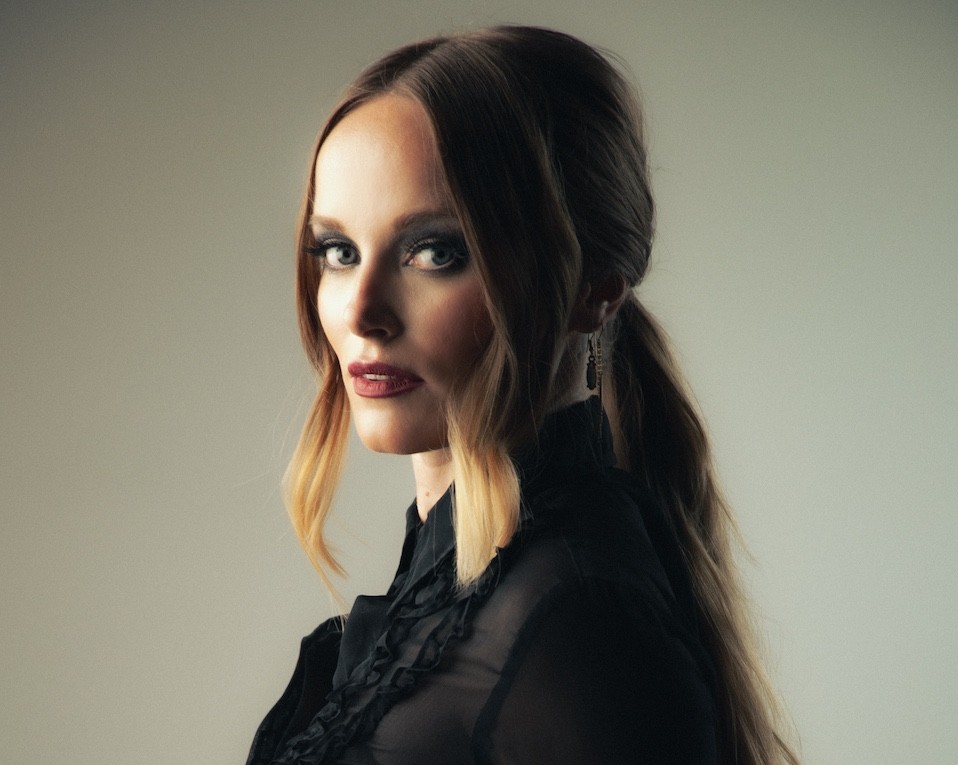
Before she was making records in Nashville studios, before she stepped into the booth with producer Dan Auerbach, before the songs on All Dressed Up took shape, Leah Blevins was a little girl in Sandy Hook, Kentucky, pushing pause and play on a boom box and trying to understand how words fit together.
“I think I was like 10 or 11,” she recalls. “It was ‘Trouble in Shangri-La’ by Stevie Nicks and I sat down with blank white paper and would push pause and play for every word and would write it down. And that’s still a record I turn on when I need to fill the nostalgia and just get back to the basics. That was like a core memory of me being like, wait—these words all go together. How does this work?”
That curiosity—part discipline, part wonder—runs through Blevins’ music today. Her 2021 debut, First Time Feeling, introduced a voice steeped in Kentucky soil and sharpened by experience, with standouts like “Little Birds” and “Beautiful Disaster.” But her forthcoming second album, All Dressed Up, produced by Auerbach, deepens that introspection. If the first record knocked on the door, this one walks through it.
Blevins’ story begins in a tiny Appalachian town. “It’s a super small town where I come from. It’s called Sandy Hook, Kentucky,” she said. “The county I grew up in there’s only like 600 people. So very much a camaraderie feeling going back home.” Crossing the Kentucky state line still brings a rush. “There’s this sense of just peace that overwhelms me. Everything slows down. The objective is to live your life instead of always having a checklist of things to do that get you to the next level.”
Music was not optional in her family—it was inherited. On her mother’s side, church was the proving ground. “I grew up singing in church because that was the major influence. Everybody sings and plays,” she said. She, her twin sister, and older sister even formed a group. “That was kind of like my step into that world.”
Her upbringing was anything but one-note. “It wasn’t like down the middle—it was all over the place,” she said. Her father was a local politician, “shaking hands and kissing babies,” while her mother struggled with substance abuse before achieving sobriety. “She’s 25 years clean now,” Blevins said with pride. When Leah was 13, she and her twin moved in with their older sister and brother-in-law, who raised them through high school. Through it all, church remained a constant—first as obligation, later as anchor.
Then there was Elvis.
“My dad was an Elvis impersonator growing up,” she said, laughing. “He had like four or five different suits. He’d throw on and spray-paint his hair.” It wasn’t Vegas-level showmanship—more county fairs and nursing homes—but the image stuck. “I wish I would have embraced it more growing up.” The thread continues: she got engaged at Graceland, on Elvis Presley’s private jet. “I was being obnoxious and touching everything, making jokes like I’m gonna pull in the energy—and I turn around and there it is.”
If church gave her harmony and Elvis gave her spectacle, school gave her structure. Blevins spent time in ROTC and credits it with shaping her mindset. “I definitely make my bed every day,” she said. “Integrity at a young age. It taught me that, you know, mind over matter—always. I’m much more capable of what I let on.”
As a child, she and her twin sang the national anthem over the school intercom most mornings. They performed at high school basketball games and local fairs, covering ’90s country artists like Patty Loveless. “That kind of was our foot in the door,” she said. Singing felt like transformation. “When I would sing growing up, it was not so much a mask—it was just I got to put on the cape and feel a nice sense of freedom.”
Yet beneath the performance was a fiercely internal writer. “I’ve always been very internal,” she said. “I’ve always journaled… just taking time for myself before the world opens up.” That habit—writing before speaking—became the backbone of her songwriting. “I always thought that I worked better when I was in a place of sadness,” she admitted. “But I’m learning that that’s just a mind frame.”
When the band she moved to Nashville with dissolved, she found herself cooking in a kitchen, waking at 3:45 a.m., unsure of her direction. “I wrote ‘Beautiful Disaster’ by myself when I was cooking… and didn’t know what direction I was going to go with my music.” Opening for Paul Cauthen changed everything. “He came out after my set and was like, ‘I want to make a record.’” Soon she was in Dallas recording First Time Feeling. “That record to me fell out of the sky,” she said. “It was a good knock on the door for everything else that’s to come.”
Now, nearly 15 years into her Nashville chapter, she sounds grounded and clear-eyed. “You can’t have an ego and live in this town,” she said. “Everywhere you look everyone’s so talented.” Her approach has never been radio-chasing. “I was never trying to write a song to be on radio. That wasn’t my approach. I think that helped me just stay authentic.”
That authenticity is at the heart of All Dressed Up. Working with Dan Auerbach—“a hero of mine and one of the best producers of our generation”—was revelatory. “It was never this easy before,” she said. “Before we would go into everything, Dan asked my opinion. We would find the key and he would say, ‘How would you sing this melodically?’ Those were things I’ve never done before.”
Auerbach’s most lasting advice was deceptively simple: “Let the microphone do the work. You don’t have to do all this business—just sing the song and be relaxed.” For a singer once tempted to overprove herself, the lesson landed. “If you just sing with conviction it has much more impact.”
Songs like “Lonely” and “Hey God” lean into that restraint, pairing desperation with quiet strength. “We’re all here in this reality involuntarily,” she said. “We’re just trying to find our way.” Vulnerability, once perceived as weakness, is now her calling card. “I used to look at vulnerability as a shortcoming,” she said. “But I feel like my vulnerability is my superpower. What’s the point in acting like I got it all together when I know I don’t?”
That candor—shaped by church pews, Elvis jumpsuits, ROTC discipline, and the winding roads of eastern Kentucky—courses through All Dressed Up. The album may carry a glamorous title, but beneath the sequins is something sturdier: a woman who has learned that strength and softness are not opposites.
When Leah Blevins sings now, she’s not hiding behind a cape. She’s standing in her own skin—accent intact, guard down, and fully aware of where she came from.
Photo credit: Jim Herrington
 About the author: A devout lover of singer-songwriters, mountain hikes, colorful cuisine, and eccentric artists, Brian D'Ambrosio lives in Santa Fe, New Mexico. For story ideas and suggestions, he may be reached at dambrosiobrian@hotmail.com.