

For a quarter century, Rod Picott lived the life his songs describe. He drove the long miles, played the rooms that smelled of beer and dust, and wrote from the inside of working days that left their marks on the body. Now 61, Picott has stepped away from touring—not from music, and certainly not from the work ethic that has always defined him—but from the relentless churn of the road itself. “I’ve retired from the road,” said Picott. “That’s what I’ve retired from.”
Picott now lives in Wimberley, Texas, a long way—psychically and geographically—from the Nashville he found increasingly restless in recent years. “The town changed,” he said simply. “The character of it changed.” After roughly 150 shows a year for 25 years—thousands of performances in all—he felt it in his bones. “I was exhausted. Down into my bones. I knew the sell-by date was coming.”
That decision, made earlier this year, carries no bitterness. There is gratitude in his voice, and realism too. Touring defined him for decades, and leaving it behind is not clean or painless. But it feels right. What remains unchanged is Picott’s commitment to the craft itself—the same workmanlike devotion that has marked his songwriting since he first figured out how to make a song stand up on its own.
Few songs make that clearer than “Sheetrock Hanger,” Picott’s blunt, autobiographical masterclass in blue-collar detail. If someone asked him to prove what he brings to songwriting, he said, that’s the song he’d point to. Others can write about working life, he noted. What they can’t do—unless they’ve lived it—is capture exactly what it feels like to have sheetrock burrs embedded in your fingertips, gas station coffee in your throat, and cracked hands on a second coat that still isn’t finished. “It’s the detail that brings drama,” Picott said. “That’s where the trust comes from.”
That instinct—earning the listener’s trust through specificity—runs through his entire catalog. It’s there in his early songs, too, including “Tiger Tom Dixon Blues,” the title track of his 2001 debut, drawn from family history. Picott’s great-uncle fought professionally in the 1930s and ’40s, a local anti-hero who drank himself to death. Another uncle boxed briefly as a pro; his father sparred in the Marines. Boxing, for Picott, is visceral and poetic all at once: two people agreeing to hurt each other, brutality edged with strange beauty.
That same stripped-down honesty defines “Sonny Liston,” from Paper Hearts and Broken Arrows (2024), inspired by Nick Tosches’ The Devil and Sonny Liston. Picott fell in love with the book about the troubled, conflicted heavyweight. The arrangement is bare, the chords simple, the lyric doing all the heavy lifting. “The lyric is the most important thing,” he said. “That’s always been the job.”
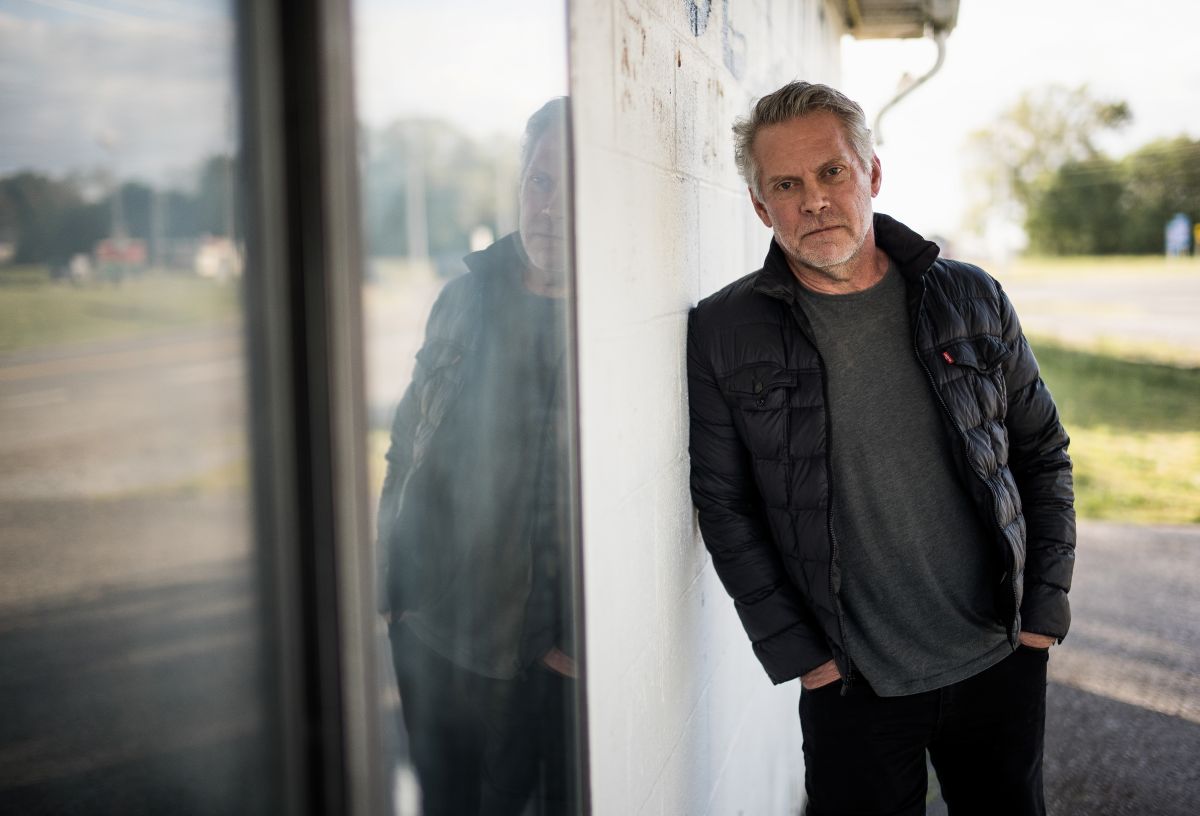
Picott’s sense of that job was shaped early. His father’s Marine Corps record collection was a strange, generous education—James Brown and Ray Charles alongside John Philip Sousa marches. An AM radio station in Dover, New Hampshire, filled in the rest, spinning everything from Motown to Johnny Cash to Led Zeppelin in a single afternoon. As a kid, Picott absorbed it all without judgment. “There’s something beautiful about that time,” he said. “You don’t know what’s cool. You’re just taking it in.”
It took longer to figure out how to make music himself. He suffered through a miserable year in a cover band after high school, then found his footing in the mid-’80s original-music scene between Portland and Boston. Seeing R.E.M. on Letterman was a revelation—not because of virtuosity, but because it felt attainable. Eventually, Picott realized he didn’t want to pull a band behind him. He wanted to be the thing. He traded his bass for an acoustic guitar and taught himself how to write.
There were no manuals then. Learning meant obsession: listening to a record 25 times, writing lyrics out by hand, puzzling over chord changes until they revealed themselves. It was frustrating and glorious, and it taught Picott something that never left him—that songwriting is labor. You get your hands dirty. You don’t dabble.
That ethic carried through uneven periods and hard-earned breakthroughs. Picott considers Welding Burns (2011) the first time he truly got everything right—the balance between spare, road-tested songwriting and full-band arrangements that didn’t dilute the songs’ force. Other records wandered slightly off-center. Some departures, like Summerbirds (2007), sound beautiful to him even as they feel like near-misses. The self-critique is relentless, but not cruel. It’s the voice of someone who sees songs as pieces of work, not precious artifacts.
That perspective has made it possible for Picott to change lanes without abandoning himself. In recent years, he’s finished a novel, started another, and begun writing fiction with the same characters who once lived inside his songs. “I’m still writing,” he said. “I’m just not putting chords behind them.” Songs haven’t lost their power for him; some ideas simply need more room than a verse and chorus allow.
What hasn’t changed is his belief in order: you write what you’re compelled to write first, then you figure out who wants it. Never the other way around. He learned early that you can’t be all things, that longevity comes from knowing who you are and staying rooted there. That stubbornness—shared and sharpened through decades-long collaboration with Slaid Cleaves—has kept his work coherent even as styles, scenes, and platforms shifted around him.
Picott hasn’t stopped making records, and he will make another. How it gets released is an open question in a constantly changing industry. What he knows is that his audience, small but fiercely loyal, will be there. And if the chemical magic of live performance—the nights when everything connects—now belongs mostly to memory, the work itself continues.
“Everything good in my life came from discipline,” Picott said. The road may be behind him, but the discipline remains. And so does the voice—scarred, precise, and earned the hard way.
Photo one courtesy of Rod Picott; photo two credit Neilson Hubbard
 About the author: A devout lover of singer-songwriters, mountain hikes, colorful cuisine, and eccentric artists, Brian D'Ambrosio lives in Santa Fe, New Mexico. For story ideas and suggestions, he may be reached at dambrosiobrian@hotmail.com.